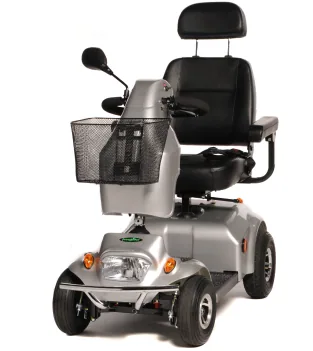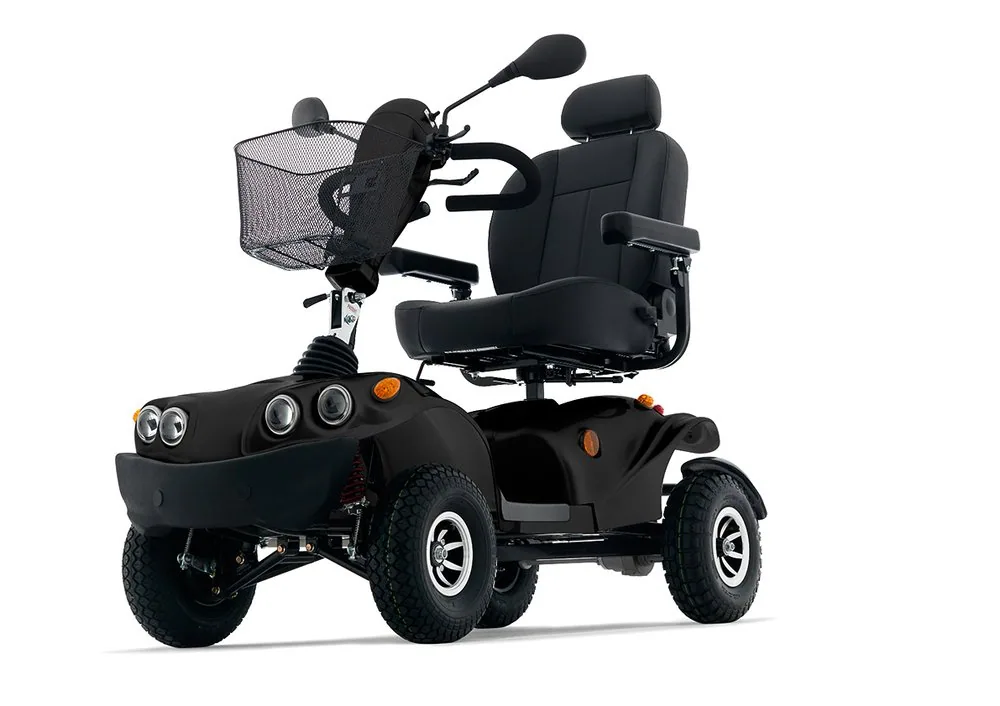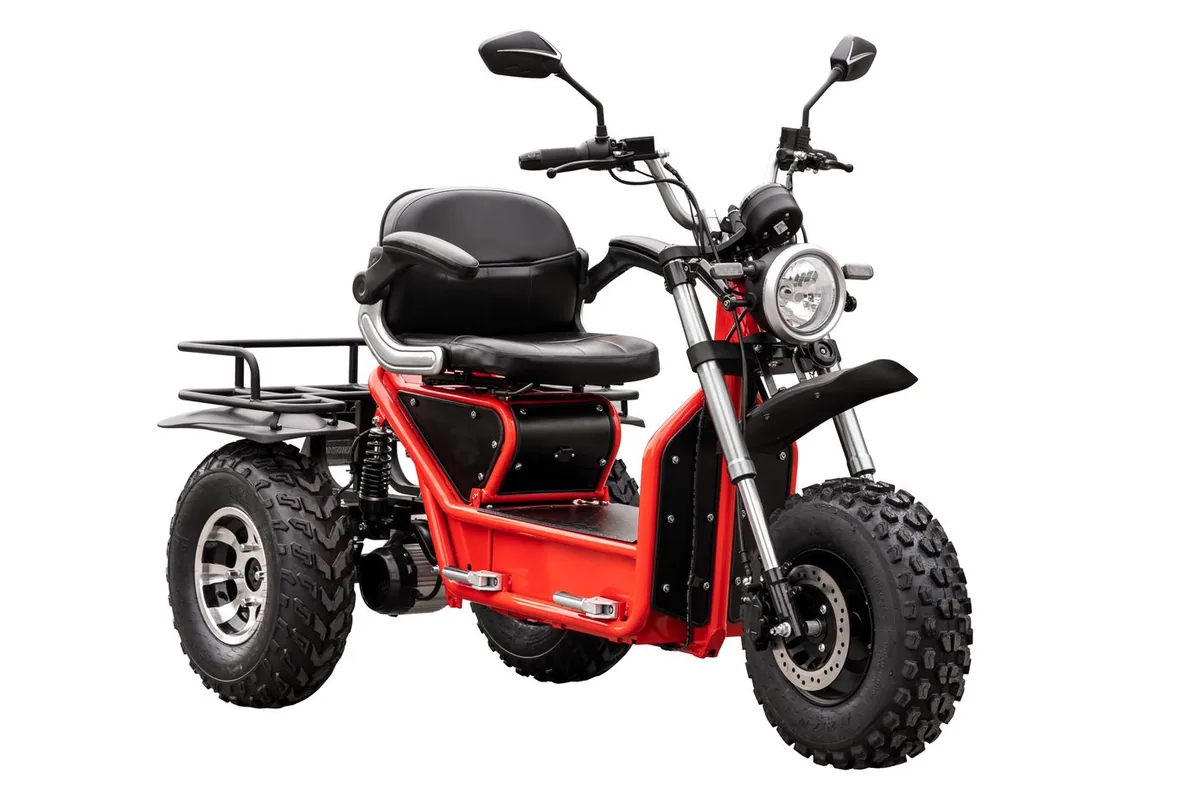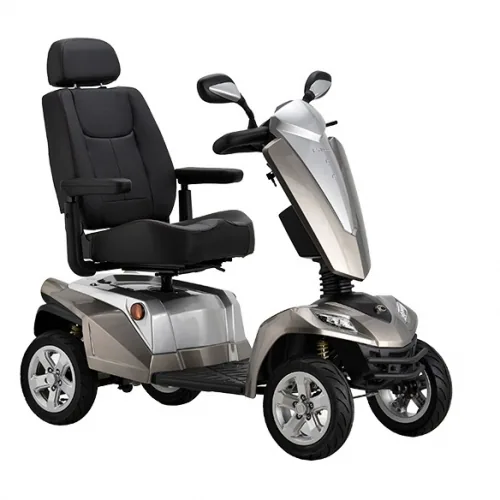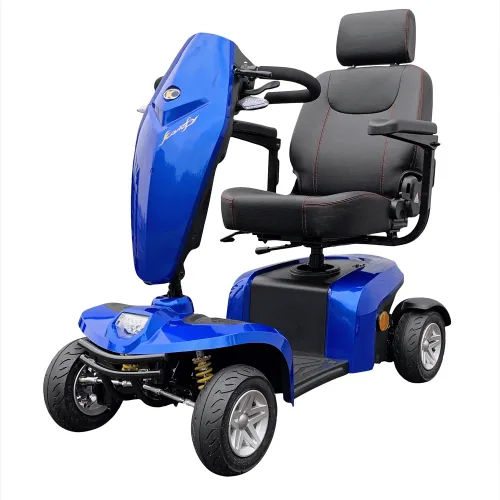
The two classes are not trim levels of the same thing. They are legal categories with different rules, different weights and different jobs. Get the class wrong and you either can't legally make the journeys you bought it for, or you're paying for road kit and 40 kg you never use.
| What matters | Class 2 | Class 3 |
|---|---|---|
| Top speed | 4 mph (6.4 km/h) | 8 mph on the road, 4 mph on pavements |
| Where you can ride | Pavements, pedestrian areas, cycle tracks | Pavements (4 mph), the road, cycle tracks |
| Where you cannot | The road, cycle lanes | Motorways, bus lanes, cycle lanes |
| DVLA registration | Not needed | Required before road use |
| Vehicle tax | None | None, once registered as a mobility scooter |
| Driving licence | Not needed | Not needed |
| Insurance | Not required | Not required, recommended |
| Required road kit | None | Lights, indicators, rear mirror, horn, efficient brakes |
| Typical weight | 50–85 kg | 100–150 kg |
| Typical range on a charge | 19–25 miles claimed | 20–35 miles claimed |
| Kerb height you can take | About 6 cm | About 10 cm |
| Fits in a car boot | Often, dismantles into parts | Rarely |
The decision is where you ride, not how fast
Ignore the speed figure for a moment. Ask what your actual route looks like. If you can get from your front door to the shop, the park and the bus stop entirely on pavement, a Class 2 does the whole job, and it does it at a weight you or your family can handle.
The moment your route includes a stretch of road with no footway — a village lane, a rural B-road, the last 300 metres to a retail park — Class 2 puts you outside the law. Class 3 is the only legal way to travel that stretch, and it comes with obligations: registration with the DVLA, lights, indicators, a rear mirror and a horn, and a 4 mph limit whenever you're on the pavement.
Registration, tax and insurance, in plain terms
Class 3 scooters must be registered with the DVLA before they go on the road. You do not pay vehicle tax once it's registered as a mobility scooter, and you get a V5C log book in the post. If the seller doesn't register a new machine for you, you register it yourself on form V55/MV, so ask before you buy rather than after.
Neither class legally needs insurance. Most owners of a Class 3 take out third-party cover anyway, because it's the machine sharing a road with cars. Neither class needs a driving licence — that requirement only bites on machines that fall outside the classes altogether (see below).
Range: what a charge really covers
Published range figures are calculated under test conditions — flat ground, a steady speed, warm weather, a rider well under the maximum load. Treat them as a ceiling. In the catalogue, Class 2 machines generally claim 19 to 25 miles (the Sterling Sapphire 2 claims 19, the Rascal Vista 24, the Shoprider Sovereign 4 and Kymco Komfy 4 up to 25), while Class 3 machines claim 20 to 35 (the Kymco Komfy 8 around 20, the Rascal 850 24, the Kymco Maxer 8 up to 35).
Cold weather, hills, headwind and heavier riders all pull that down, and the last 20% of a battery is where a scooter starts to feel slow. If your regular round trip is 10 miles, buy for 20.
Kerbs, camber and ground clearance
Class 2 scooters are built around the pavement they were designed for: shorter, narrower, a lower top speed, and a maximum kerb climb of around 6 cm on models like the Rascal Vista. Class 3 machines are built for mixed surfaces — a 10 cm kerb on the Rascal 850, more ground clearance, bigger pneumatic wheels and suspension that soaks up a potholed road.
If your pavements are the old, high-kerbed kind, or your route crosses a dropped-kerb-free junction, that difference is the one you'll feel every day. Measure the worst kerb on your route before you buy.
Weight, lifting and boot space
This is where Class 2 wins outright. Boot scooters such as the Pride Revo 2.0 and the Shoprider Sovereign 4 come apart into pieces, and the heaviest single part is around 25 kg — heavy, but two people can manage it. A Class 3 road scooter is a different animal: the Kymco Maxer 8 weighs 138 kg with a heaviest part of 52.5 kg, and the Sterling S700 is 146 kg. That is not going in a hatchback, and it is not going up a step.
Class 3 machines also need somewhere to live: a garage, a shed with power, or a level path to a covered charging point. The battery has to come out or the scooter has to be next to a socket.
Turning circles and doorways
A Class 2 is usually 118–125 cm long and 53–59 cm wide, with a turning radius around 1.3–1.4 m — enough for a hallway and most garden gates. A Class 3 runs 127–154 cm long, 64–74 cm wide, with turning circles from 1.4 m on the compact Sterling S425 (135 cm long) up to around 4 m on a luxury scooter like the Rascal Vortex. Measure the narrowest doorway and the tightest corner inside the house, not just the pavement outside.
Which machines sit in which class
In the current range, Class 2 is where you'll find the compact and boot-friendly machines: the Rascal Vista and Vista DX, the Sterling Sapphire 2, the Shoprider Sovereign 4 and the Kymco Komfy 4. Class 3 is the road scooters: the Rascal 850, Rascal Pioneer, Rascal Vision, the Sterling S425, S700, S800 and Elite 2, the Pride Colt Sport 2 and Baja Bandit, the Kymco Maxer 8, the Shoprider Cordoba and the Roma Granada. Browse the full range at mobility scooters, or go straight to Rascal, Sterling or Pride.
If budget is the deciding factor, refurbished rides include mobility scooters, and each one states its condition and its warranty period on the product page — 3 to 6 months on refurbished, against at least 12 months on a new machine.
Machines that are in neither class
One trap worth knowing. A scooter that can exceed 8 mph, is wider than 0.85 m, or weighs more than 150 kg is not in either class. Under the DVLA rules it can be used on the road only — not on pavements, not on cycle tracks — and it needs both a driving licence and registration. Some high-performance and off-road machines sold in the UK have a private-land speed mode above 8 mph, and the Invader is one example in this catalogue. Keep it to 8 mph on the road, or you're outside the class and outside the law.
Delivery, and why it's two people
Mobility scooters go out by a specialist two-person courier who contacts you to arrange the delivery day, and leaves the machine at the ground-floor threshold. That matters with a 138 kg road scooter and a flight of steps. Delivery is a flat £45 per order to any UK address, including the Highlands and Islands, Northern Ireland, the Isle of Man, the Isles of Scilly and the Channel Islands, and takes 3–7 working days: 2–5 handling, then 1–2 in transit. Full detail on delivery and shipping.
Before you order, have the answers to four questions ready: how far you need to go on one charge, the height of the kerbs on your route, whether it has to fit in a car boot or through a doorway, and the heaviest part you'd have to lift. Tell us those and we'll tell you which machines genuinely fit — that's the whole of the mobility scooter buying guide, and you can also call or WhatsApp us before ordering.
Choose Class 2 if…
- Every journey is on pavement, in a pedestrian area or on a cycle track.
- It has to go in a car boot, or into a small hallway, or up a couple of steps into the house.
- Someone else has to lift part of it.
- You want the simplest legal position: no registration, no paperwork, no road kit.
Choose Class 3 if…
- Your route includes any stretch of road — a rural lane, a B-road, a link road to a retail park.
- You want to keep up with traffic at junctions and be seen doing it, with lights and indicators.
- You need the range and the bigger wheels: 20 to 35 miles claimed, 10 cm kerbs, suspension.
- You have a garage, shed or level charging point, and somewhere to keep a 100–150 kg machine.
If you're still torn, tell us the route and we'll tell you the class. We'd rather talk you out of the wrong scooter than sell you one that can't leave your street.